

Changing negative thinking patterns
This page offers helpful hints and tips for reframing and changing negative thinking patterns
I’m worried my child is always thinking negatively
She always seems so low and helpless
He is beginning to avoid doing things I know he enjoys
I just can’t help them think clearly
Whenever you see this symbol  there is a linked website article for more information
Click HERE for a printable version of this page - Reframing Thoughts
---------------------------------------------------------------------------------------------------------------------------------
We all hold worries and negative thoughts in our minds from time to time. Sometimes they are helpful and ensure we make safe choices; at other times we have negative thoughts which may be dramatic but we can work through them and overcome the weight of the thoughts in our minds.
Children often need help and support to get to the point where they are able to recognise the difference between helpful negative thoughts (for things like safety) and unhelpful negative thoughts (things such as catastrophic ideas or irrational thoughts) which can stop us from interacting with the world around us or alter our responses to things or people.
Your child may say things like…
“It’s not safe, I can’t go there.” “No one likes me.” “I am never going to be able to do this.” “There is no point, I am useless.”
We sometimes refer to these thoughts as unhelpful thinking or catastrophising.
A process called ‘Cognitive Reframing’ can help alter the existing thought and move it to being more helpful or supportive to the individual.
Cognitive Reframing is when you shift your mindset by considering the situation, person, or relationship from a different perspective.
As this is a mindset shift, you can do this at anytime, anywhere.
By changing your thoughts on something, you will often find behaviours and feelings around the situation change alongside it.
----------------------------------------------------------------------------------------------------------------------------------
Breaking those emotions down and gently challenging the overwhelming feelings
Imagine using a microscope – first of all you zoom in using the macro lens and see very specific
details (often the part that is affecting us negatively the most), when you zoom out slightly you can
see how the details fit as part of a whole (offering a little more perspective).



Photograph by Saatchi Art Photography by Bobscaping
This can be a really helpful analogy to use when supporting young people who may be struggling
with one aspect of a situation without considering the wider picture.
For Example:
I am worried because I am crying lots. Support the child/young person to consider all the other
things happening at the moment for them: Feeling sad because they are tired, hungry and worried
about upcoming exams.
It makes more sense and helps to link the emotions and the situation.



Consider which parts can be changed.
E.g. I can go and get a drink/snack. I could go for a walk and notice things around me to take a
break from the thoughts linked to revision/exams.
----------------------------------------------------------------------------------------------------------------------------------
How thoughts, feelings and actions can be linked
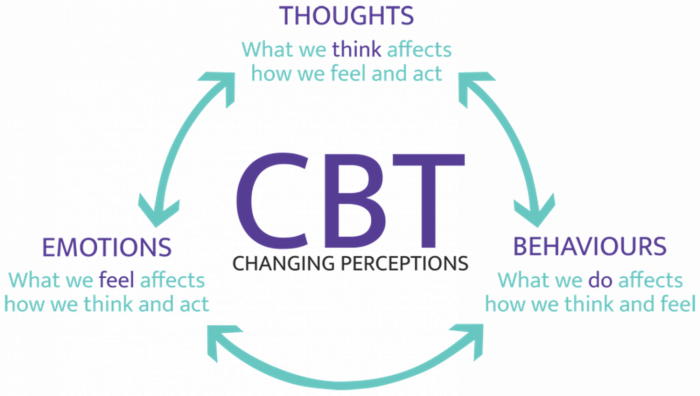
(Image from RPTherapies)
By supporting your child to change the way they think, will change the way they feel and behave.
Encourage your child to replace negative thoughts with kind ones.
E.g. Am I being kind to myself? What would a friend/loved one say to this voice/thought?

----------------------------------------------------------------------------------------------------------------------------------
Managing Overwhelming Physical Sensations
To support your child to manage the physical sensations such as sweating, breathing changes, headaches, or tummy pains, encourage them to do some deep breathing and relaxation activities such as walking in nature or yoga (more support and visual aids are included below).
To support with the overwhelming emotions, encourage your child to consider…
 Is the information reliable?
Is the thought a helpful one?

Will you think about this/the impact of the thought for more than 5 minutes in 5 years’ time?
If not, limit the time you spend thinking about it now to less than 5 minutes. 
----------------------------------------------------------------------------------------------------------------------------------
Calming the central nervous system at times of distress
Breathing is a powerful way of interrupting unhelpful thoughts and feelings and calming the central nervous system at times of distress.
Here are some visuals to help support your child with calming breathing. Practicing these breathing exercises when calm is a great way to become fluent at using them before they are needed in a crisis.
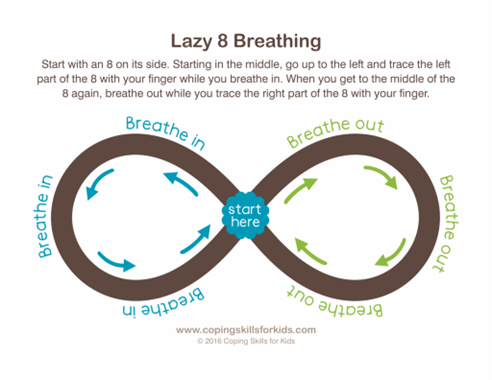
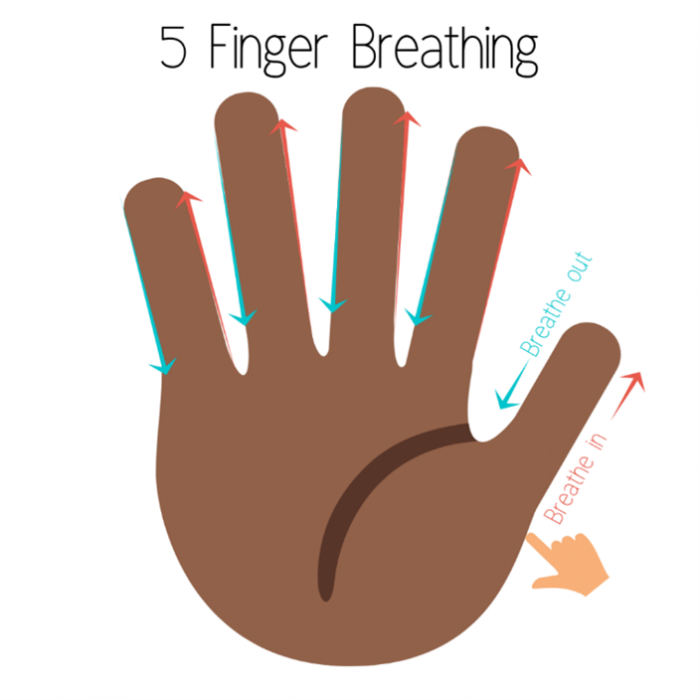
Image from www.thecalmcorner.com 
Go up the fingers counting to 4 and down counting to 8. (You can add a pause at the top of each finger for a count of 7). If any of the breathing patterns make you feel dizzy, stop and take some normal breaths.
Here are a few ideas for reframing thinking
| Instead of.......... | Try thinking......... |
|
I am going to fail |
What am I missing? |
|
This is too hard |
I'm making my first steps |
|
He's so smart, I will never be that clever |
How does he do it? I'm going to find out so i can improve what I do |
|
I'm ugly
|
I am me, there is no other me and people love me for who I am |
|
I will never feel happy again
|
This moment of happiness happened today. I wonder what moment of happiness I will find tomorrow. (These can be as small as enjoying a warm drink/snack or feeling air against your skin)
|
----------------------------------------------------------------------------------------------------------------------------------
Consider how you view your child’s behaviours which may be linked to anxiety or fear.
Focus on being curious as this often leads to new ideas for ways you can offer support.

@kwiens62
---------------------------------------------------------------------------------------------------------------------------------
Video Links
The Educational Psychology Service have many more resources and great clips to support parents on their website here.
This section specifically focuses on Emotional Based School Avoidance, although, many of the approaches explore changing thoughts, feelings and behaviours which can be applied to feeling overwhelmed and anxious in many different contexts.
Within this webpage there are resources and videos for parents, young children and older children.

There is also a really helpful interactive tool to use with children by the Somerset Educational Psychology Service available here.
Emotion Coaching: Workshop for parents and teachers can be found here.
Understanding Anxiety in Children by B. Cumming & K. Perry South Bristol CAMHS service.
----------------------------------------------------------------------------------------------------------------------------------
Easy use books to read as parents and some to share with your child or young person
- Helping your child with Fears and Worries - Cathy Cresswell and Lucy Willetts
- Don’t Worry, Be Happy: A Child’s Guide to Dealing With Feeling Anxious - Poppy O’Neill
- Be Strong: You Are Braver Than You Think - Poppy O’Neill
- Starving The Anxiety Gremlin: A Cognitive Behavioural Therapy Workbook on Anxiety Management for Young People - Kate Collins-Donnelly (2 versions one for Age 5-9 years and one Age 10-16 years)
- The Huge Bag of Worries - Virginia Ironside
- The Worrysaurus - Rachel Bright and Chris Chatterton
- Ruby’s Worry: A Big Bright Feelings Book - Tom Percival
- The Invisible String - Patrice Karst and Joanne Lew-Vriethoff
- The Worry Workbook: The Worry Warriors’ Activity Book - Imogen Harrison
- No Worries! Mindful Kids: An activity book for children who sometimes feel anxious or stressed - Dr Sharie Coombes and Katie Abey
 Click HERE for a printable version of this page - Reframing Thoughts
With thanks to Somerset Educational Psychology Service (EPS) for their work with us in developing this resource page

