

Supporting Behaviour
It just feels so hard, nothing I do makes a difference!
They are so hard to reach, they don’t seem to care!

They never listen to me!
I can’t seem to do the right thing, no matter what I try!
Supporting behaviour can be really difficult at times, especially when the support you feel you are offering as a parent/carer doesn’t appear to be making a difference.
Helping children navigate their feelings and behave in an appropriate way is often a difficult part of parenting. One strategy may work for one child but not another, and this can often leave parents feeling overwhelmed and unsure what to do for the best.
Challenging behaviour is often the result of a child feeling intense emotions that they do not feel able to handle, this may be anger, frustration, sadness or fear. In order to decide how best to support your child, a good starting point is to look beyond the behaviour to explore what emotions may be underpinning their feelings. Become a curious support to your child – wondering in on what might be going on for them.
Whenever you see this symbol  there is a linked website article for more information
 Click HERE for a printable version of this page
----------------------------------------------------------------------------------------------------------------------------------
How can I support my child to manage strong feelings?
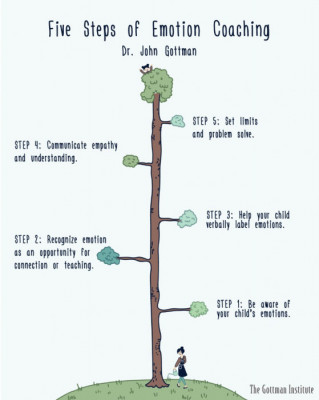
Emotion coaching is one way to help support children (or adults!) with their emotions, and involves a stepped process that seeks to recognise, empathise and connect with the child’s feelings, helping them to label their emotions and feel supported without judgement about the accompanying behaviour. This then allows the introduction of limit setting (for example no hitting) and problem solving if the child has settled enough to engage collaboratively.
Five steps of emotion coaching
Our understanding of behaviour has broadened since the middle of the 20th Century, where we used to understand the management of behaviour purely in terms of consequences and rewards.
Now, with advances in neuroimaging we have a greater understanding of the structures of the brain and how they respond to stimuli, and how best to support a person to calm before placing extra cognitive pressures on them.
More information on the image below (The Gottman Institute (2017)) and the Gottman approach can be found here: How to Strengthen Your Child's Emotional Intelligence (gottman.com)
Step 1
- Be aware of emotions.
- Tune in to the child’s feelings and your own.
- Pay attention to your own emotions from happiness to sadness to anger.
- Understand that emotions are a natural and valuable part of life.
- Observe, listen and learn how the child expresses different emotions.
- Watch for changes in facial expression, body language, posture and tone of voice.
Step 2
- Use emotional moments as opportunities to connect.
- Play close attention to a child’s emotions.
- Try not to dismiss or avoid them.
- See emotional moments as opportunities for teaching.
- Recognise feelings and encourage your child to talk about his/her emotions.
- Provide guidance before emotions escalate.
Step 3
- Listen to the child.
- Respect the child's feelings by taking time to listen carefully.
- Take the child’s emotions seriously.
- Show the child that you understand what he/she is feeling.
- Avoid judging or criticising the child’s emotions.
Step 4
- Name emotions, this helps to soothe the child.
- Identify the emotions your child is experiencing instead of telling the child how they should be feeling.
- Set a good example by naming and talking about your emotions.
- Help build an emotional vocabulary.
Step 5
- Explore solutions to problems together.
- Redirect misbehaving children for what they do, not what they feel.
- Encourage emotional expression but set clear limits on behaviour.
----------------------------------------------------------------------------------------------------------------------------------
The Anxiety Curve
 The anxiety curve is a useful diagram which indicates how to support a child, young person or adult who may be displaying certain behaviours as a result of being emotionally dysregulated.
Click here to learn more about the Anxiety Curve, an approach created by , K.D., & Curtis, M. (2003)
Anxiety Curve Fact sheet available here.
----------------------------------------------------------------------------------------------------------------------------------
There are lots of great resources for parents, children and young people on the Educational Psychology website found here. There are informative videos as well as posters you can use at home to support your child understanding their strong feelings.
There is also an interactive workbook produced by the Educational Psychology Service, which can be found here, to help children with overwhelming feelings of worry.
----------------------------------------------------------------------------------------------------------------------------------
What can I do to help prevent challenging behaviour in the first place?
There are a few simple things that adults can do to help children and young people manage their feelings. Firstly, try to keep instructions simple, for example “first put your shoes on then your coat”, and do not place too many demands at once.
If your child is young, you may find it useful to crouch down to their level when communicating with them, particularly when asking them to do something they may not wish to do. If your child is older, ensure you are offering positive eye contact when giving instructions.
Another strategy to help children manage their feelings and gain a sense of control is to use a timetable at home to help your child or young person understand and remember the plan of the day.
This can be in written or visual form depending on the age of your child.
Finally, it can really help children to gain a sense of security if all adults are implementing consistent and clear rules and responses.
Emotion Coaching Workshop for parents and teachers
Emotion Coaching Management Styles
----------------------------------------------------------------------------------------------------------------------------------
How can I find the energy to put all this in place to help my child?
It can be difficult to find time to take care of your own needs when you are a parent or a carer. However, it is important to factor in time for activities which help you to de-stress to prevent feeling of being overwhelmed.
Here are some strategies and ideas which may help. Choosing one of these each day to complete can make such a difference to the support you can offer to your child.
- Take time to be present with yourself and your own feelings using techniques such as meditation or just being mindful during everyday tasks such as walking the dog.
- Sit in an outdoor space without any other distractions (phone away) for just 3-5 minutes.
- Take a bath, light a candle and watch the flame.
- Write your own three things each day you are grateful for, however small, e.g., the sun is shining/I managed to do one load of washing.It is important to celebrate successes.
- Take a moment to have a drink and snack without interruption.
- Read or watch a magazine or programme in comfy clothing.
- Go for a walk or cycle outside.
- Try to get enough good quality sleep.

----------------------------------------------------------------------------------------------------------------------------------
I am concerned that my teenager is behaving inappropriately for their age?
It can be difficult to know when to worry about your child’s behaviour, this is particularly challenging once they are teenagers.
The stages of adolescent development chart below can be used as an approximate guide to get a sense of what behaviour can be expected.
However, it is important that this remains purely a guide, if you are concerned, please seek support from a professional – your GP, a local sexual health clinic or education setting staff can all help you.
There is more detailed information around stages of adolescent development available here in this online article by the charity Act for Youth.
Behaviours you can expect to see at Stages of Adolescence Development
| 10-14 years of age | 15-16 years of age | 17-21 years of age |
|
|
|
Click HERE for a printable version of this page
With thanks to Somerset Educational Psychology Service (EPS) for their work with us in developing this resource page

